Claude Fable 5.2 API price: bench and when to use it
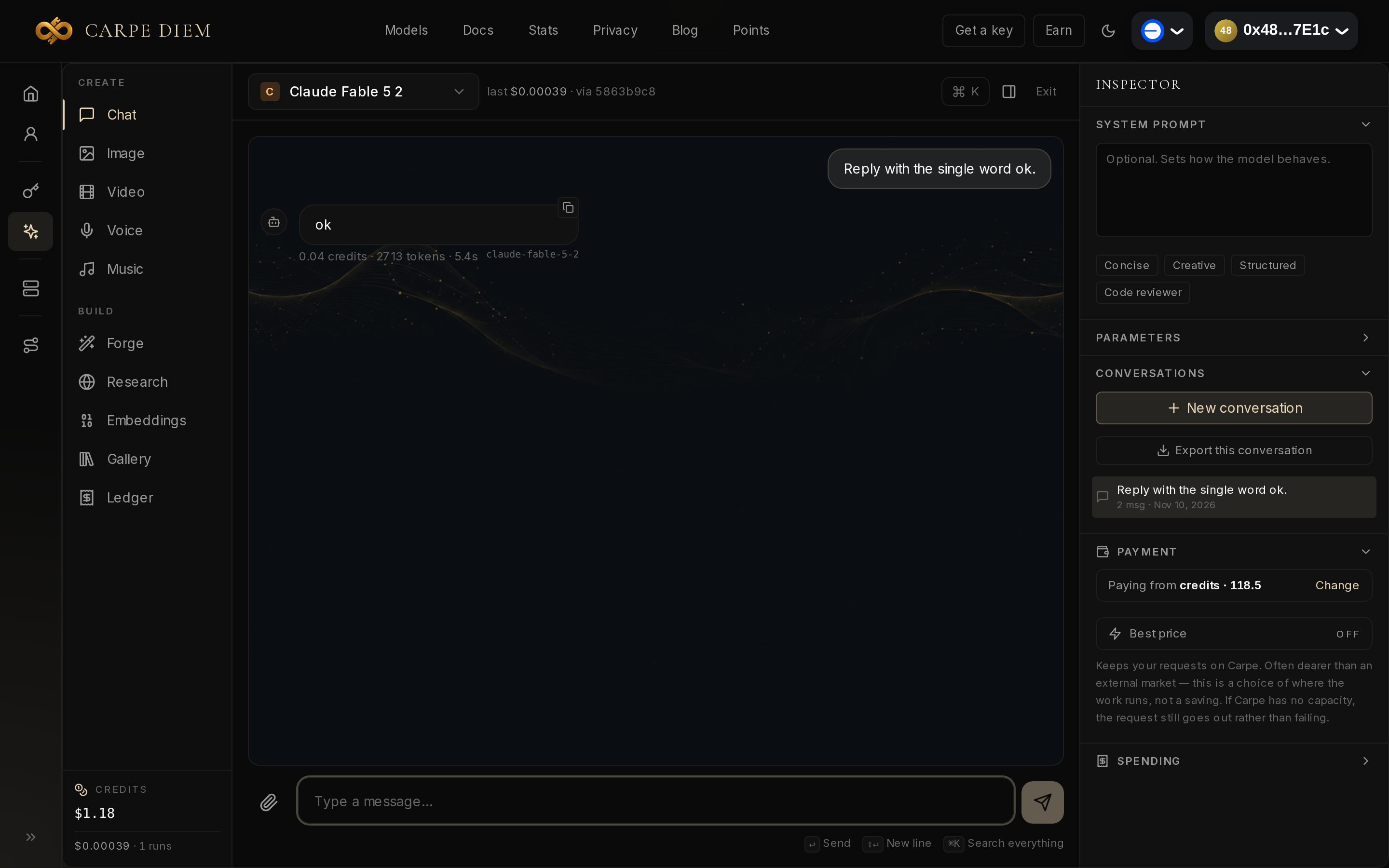
Claude Fable 5.2, announced by Anthropic on 9 November, has been available on Carpe Diem under the id claude-fable-5-2 since 10 November. At the time of our test it cost about $3.81 per million input tokens and $19.05 per million output tokens, versus $8 and $40 on Venice. It solved the arithmetic, the JSON, and the needle in a long text. What remains is when it is worth twice Opus 5.5.
Claude Fable 5.2 in brief
Anthropic presents it as its most capable model for hard technical work: agent coding, research, finance, design. The official announcement states that Fable and Mythos share the same underlying model; Mythos stays behind verification programmes. At Anthropic, the rate is lower than Fable 5.1. A fast mode exists on their platform; we neither saw it nor measured it on Carpe Diem.
The catalogue lists vision, reasoning, function calling, structured output, web search, multiple images per request, and a million-token window. It is classed anonymized: Venice forwards your requests to Anthropic, which sees the content but not the sender. If your prompts must stay on a private model, pick another one.
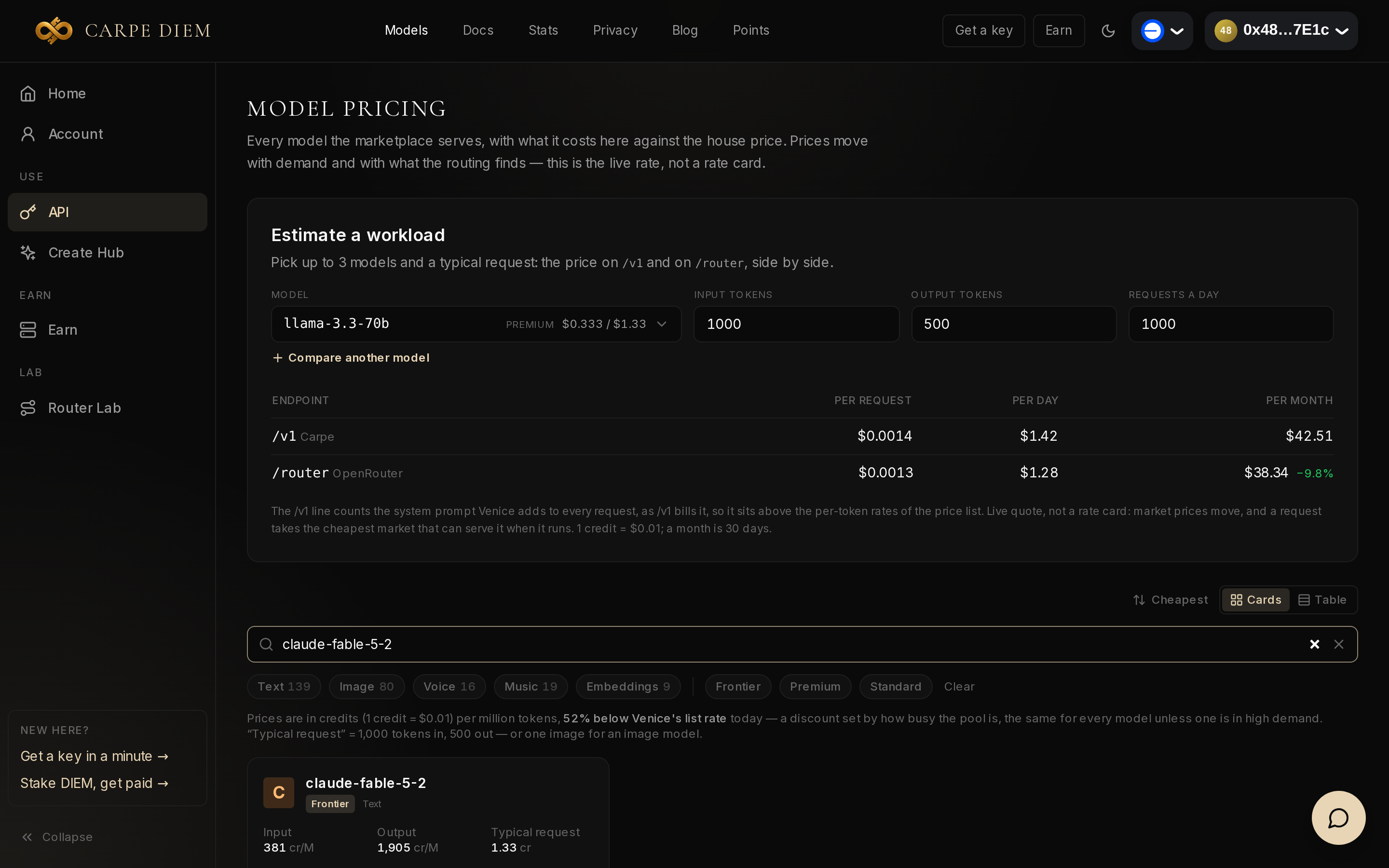
Price: $22.86 for a thousand average requests
A thousand requests of 1,000 input tokens and as many output tokens come to $22.86 on Carpe Diem, versus $48 direct on Venice. The price follows spare capacity during the day: check /models before you budget a large volume.
| Input / M | Output / M | 1,000 requests (1k / 1k) | Privacy | |
|---|---|---|---|---|
| Claude Fable 5.2 (Carpe Diem) | $3.8102 | $19.0510 | $22.86 | anonymized |
| Claude Fable 5.2 (Venice) | $8.0000 | $40.0000 | $48.00 | — |
| Claude Opus 5.5 | $1.9051 | $9.5255 | $11.43 | anonymized |
| Kimi K3.1 Pro | $0.9525 | $4.7627 | $5.72 | private |
For short, frequent calls, add venice_parameters.include_venice_system_prompt: false: without that field, Venice adds its own system prompt, about 1,700 tokens billed on every call.
Bench: valid JSON, arithmetic in a few seconds
The full bench cost under $0.06. Fable found the break-even threshold, recovered the 7319-KESTREL reference hidden in a text of about 2,500 words, and returned JSON (vendor, amount, date, two line items) matching the schema on the first try. The French paragraph on a model router is correct on reading, aside from addressing the reader as tu. The first token arrives in a little over one and a half seconds.
| Test | Result | Duration |
|---|---|---|
| Reasoning (break-even) | correct, 40000 | 6.7 s |
| JSON extraction | valid | 2.0 s |
| Needle in the long text | found | 2.5 s |
| French writing | correct on reading | 7.4 s |
JavaScript (compressRanges) |
6/6 | 6.9 s |
The compressRanges function it returned, extracted and run separately, passes all 6 cases. That is the code the model wrote during this test.
Fable, Opus 5.5, or a cheaper model
Anthropic recommends starting with Opus 5.5 for most coding and knowledge tasks, and stepping up to Fable for the most ambitious, open-ended work. On Carpe Diem, Opus 5.5 costs about half. We did not rerun our bench on it.
For JSON extraction or a short calculation, Kimi K3.1 Pro and GPT-6.1 Terra stay much cheaper. Fable is worth it if you specifically want this Anthropic model for agent coding or a long task, not for JSON extracts a cheaper model handles just as well.
First call with a Carpe Diem key
Create a cdm_ key, then export CARPE_API_KEY=cdm_your_key_here and OPENAI_BASE_URL=https://carpe-diem.xyz/api/operator/v1. The snippet installs nothing: urllib is enough.
import json
import os
import urllib.request

url = os.environ["OPENAI_BASE_URL"].rstrip("/") + "/chat/completions"
req = urllib.request.Request(
    url,
    data=json.dumps(
        {
            "model": "claude-fable-5-2",
            "messages": [{"role": "user", "content": "Reply with the single word ok."}],
            "venice_parameters": {"include_venice_system_prompt": False},
        }
    ).encode(),
    headers={
        "Authorization": "Bearer " + os.environ["CARPE_API_KEY"],
        "Content-Type": "application/json",
    },
    method="POST",
)
with urllib.request.urlopen(req, timeout=90) as resp:
    headers = dict(resp.headers)
    body = json.loads(resp.read().decode())

print(body["choices"][0]["message"]["content"])
usage = body.get("usage") or {}
print("prompt_tokens", usage.get("prompt_tokens"))
print("completion_tokens", usage.get("completion_tokens"))
print("x-carpe-cost-usdc-micro", headers.get("X-Carpe-Cost-Usdc-Micro") or headers.get("x-carpe-cost-usdc-micro"))
print("model", body.get("model"))
ok
prompt_tokens 18
completion_tokens 21
x-carpe-cost-usdc-micro 469
model claude-fable-5-2
Method: test on 10 November 2026, one run per task, short text only. Vision, tools, reasoning_effort, and the million-token window were not tested.
To compare other rates for the day, see the catalogue and estimator. For the same test without code, open claude-fable-5-2 in the Create Hub and send it your own code task.