GPT-6.1 Terra API price, bench, and when to use it

GPT-6.1 Terra is on Carpe Diem as openai-gpt-61-terra, at $0.5711 / $2.8557 per million tokens on the 28 October reading, 43% under Venice ($1 / $5). OpenAI presents it as a mid-tier model, with vision and computer use, announced on 26 October. Our 27 October bench returned valid JSON in 1.8 s and solved a break-even threshold in 3.8 s.
Illustration generated with seedream-v5-lite on Carpe Diem.
What Terra accepts and where your data goes
Terra accepts text and images, and replies in text. Audio and video are not supported. The OpenAI card targets visual reasoning (matching a photo to a product sheet, reading a technical drawing) and computer use. The Carpe Diem catalogue also gives it reasoning, reasoning.effort, tool calling, a response schema, web search and 1,050,000 tokens of context, matching the OpenAI card. OpenAI's id is gpt-6.1-terra; ours is openai-gpt-61-terra.
Privacy anonymized: Venice forwards the content to OpenAI, which sees it and processes it under its own policy. Detail on the privacy page. If your prompts must not leave a private model, Terra is the wrong pick, even at 43% under Venice.
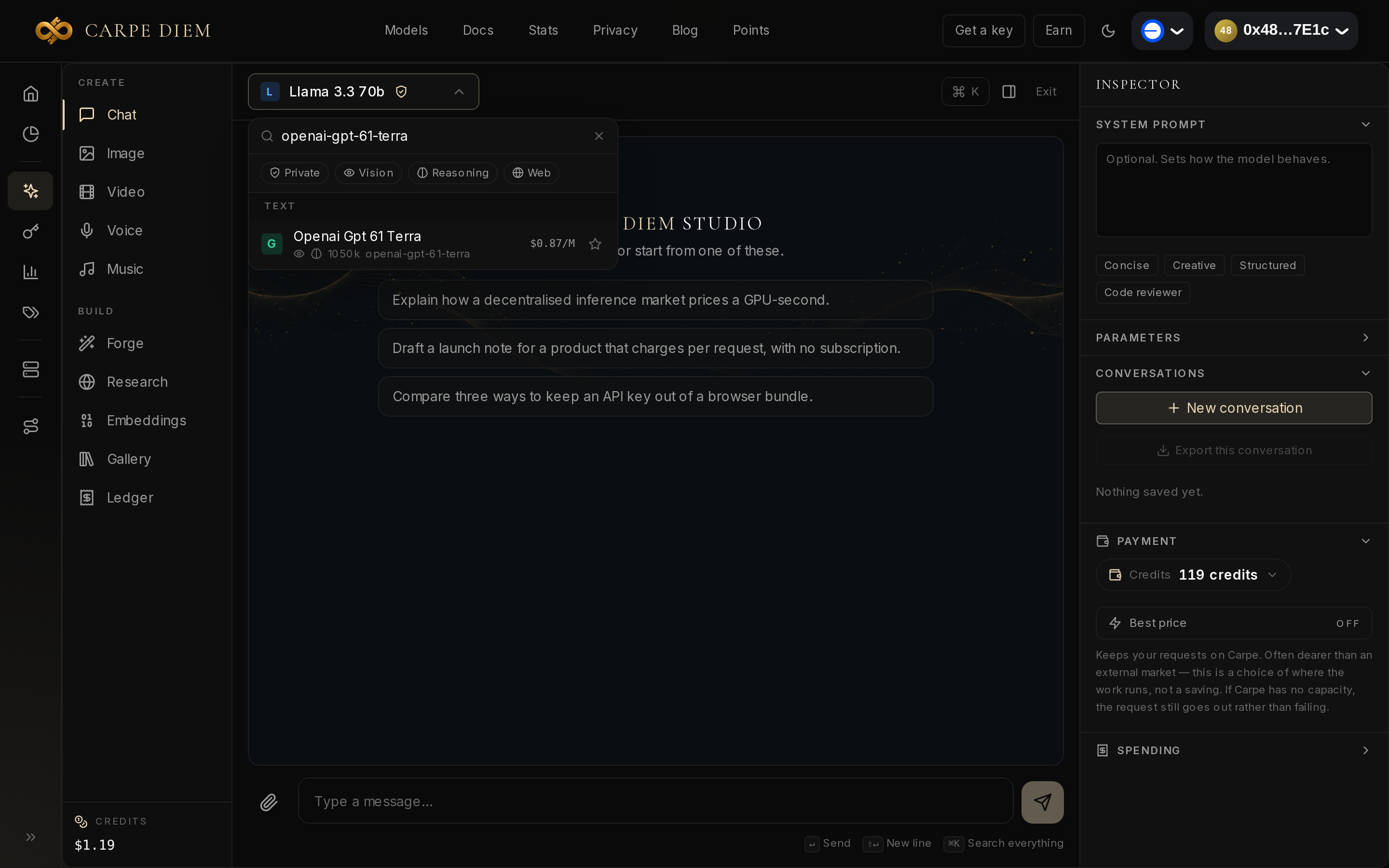 Hub picker on 27 October: 1,050 k context. The $0.87/M shown is that day's rate, the one the bench was billed at.
Prices on 28 October: $0.57 / $2.86 per million
Carpe Diem resells inference via Venice. On 27 and 28 October, the input gap versus Venice went from 13% ($0.8723, the bench rate) to 48% ($0.5235). On the latest reading, $0.5711 / $2.8557, 43% under Venice. A thousand requests at 1,000 input tokens and 1,000 output tokens cost $3.43 here, $6.00 direct at Venice. Check /models before you budget: the rate moves from one day to the next.
| Input / M | Output / M | 1,000 requests (1k in / 1k out) | Context | Privacy | |
|---|---|---|---|---|---|
| GPT-6.1 Terra (Carpe Diem) | $0.5711 | $2.8557 | $3.43 | 1,050,000 | anonymized |
| GPT-6.1 Terra (Venice) | $1.0000 | $5.0000 | $6.00 | — | — |
| GPT-6.1 Sol | $1.1423 | $5.7115 | $6.85 | 1,050,000 | anonymized |
| GPT-5.6 Terra | $1.1423 | $6.8538 | $8.00 | 1,000,000 | anonymized |
| Mercury 3 | $0.0571 | $0.1999 | $0.26 | 1,000,000 | anonymized |
Unless you set venice_parameters.include_venice_system_prompt: false, Venice prefixes its system prompt and bills it. Our line “Reply with the single word ok.” without that field inflated input to 1,689 tokens. With the field, the same prompt went to 13 input tokens. On a long chat, those ~1,700 tokens disappear in the noise. On a thousand one-line calls, they become the main line item: cut the prefix on the first try.
Bench of 27 October: valid JSON in 1.8 s
One run per test, billed at the 27 October rate ($0.8723 / $4.3616 per million), same battery as in the Mercury 3 article. We did not exercise vision, tools, reasoning.effort, or the 1,050,000-token window: the bench is short text. The needle sat in about 2,500 words. The code test was not scored: our harness did not find its test file. Terra still returned a compressRanges function in JavaScript; we did not run it.
| openai-gpt-61-terra | |
|---|---|
| First token | 1,029 ms |
| Reasoning | OK, 40000 · 3.8 s |
| JSON | valid · 1.8 s |
| Needle (~2,500 words) | found · 1.7 s |
| FR writing | 87 words · 2.5 s |
| Bench cost | $0.00625 |
The first token arrived in 1,029 ms, fine for chat, not for autocomplete. Reasoning asked from how many requests a $12 monthly fee, but $0.30 less per thousand, becomes cheaper. Expected answer: 40000. Terra answered 40000, in 3.8 s, for $0.00088.
The JSON had vendor, amount_usdc 42.50, date 2026-03-03 and the two line items, in 1.8 s for $0.00032. The needle 7319-KESTREL came back as-is; it is the most expensive test on the bench ($0.00365 of $0.00625), because of input size. The French writing, judged by reading, is correct, fluent, without errors: 87 words on what a model router does.
When to pick Terra over Mercury 3
Mercury 3 for short JSON extraction and arithmetic: the same valid JSON in 0.9 s (versus 1.8 s) and the same 40000 in 1.5 s (versus 3.8 s) on our 23 October bench, at $0.0571 / $0.1999 per million, about a tenth of Terra's price. Those gaps rest on one run per model, five days apart. Mercury 3 is anonymized too: it is not the private alternative.
Terra if you need vision (the catalogue does not give it to Mercury 3) or an OpenAI model already in your stack. GPT-5.6 Terra, higher in the OpenAI range, is $1.1423 / $6.8538 per million here; we did not measure it. Sol costs twice GPT-6.1 Terra ($1.1423 / $5.7115) and we did not bench it. If the data must stay private, neither Terra nor Mercury 3: the content goes to the maker.
A Python call that strips the Venice prompt
Create a cdm_ key in the dashboard. Export CARPE_API_KEY=cdm_your_key_here and OPENAI_BASE_URL=https://carpe-diem.xyz/api/operator/v1. The snippet installs nothing: urllib is enough. It strips Venice's system prompt and prints the reply and the tokens.
import json
import os
import urllib.request

url = os.environ["OPENAI_BASE_URL"].rstrip("/") + "/chat/completions"
req = urllib.request.Request(
    url,
    data=json.dumps(
        {
            "model": "openai-gpt-61-terra",
            "messages": [{"role": "user", "content": "Reply with the single word ok."}],
            "venice_parameters": {"include_venice_system_prompt": False},
        }
    ).encode(),
    headers={
        "Authorization": "Bearer " + os.environ["CARPE_API_KEY"],
        "Content-Type": "application/json",
    },
    method="POST",
)
with urllib.request.urlopen(req, timeout=60) as resp:
    body = json.loads(resp.read().decode())

print(body["choices"][0]["message"]["content"])
usage = body.get("usage") or {}
print("prompt_tokens", usage.get("prompt_tokens"))
print("completion_tokens", usage.get("completion_tokens"))
ok
prompt_tokens 13
completion_tokens 5
The Hub is described in the Create Hub article; the API, in the Python SDK. Create a key, run the snippet, then replace the prompt with a real JSON extraction: our 27 October bench cost $0.00625.