Qwen 4 Max or Gemini 4 Hydrogen: 4x cheaper, except for writing
On the same bench, Qwen 4 Max cost about $0.011 and Gemini 4 Hydrogen $0.044, almost four times as much. Both found the break-even threshold, returned valid JSON, and spotted the needle hidden in the text. Hydrogen wrote a paragraph in French; Qwen exhausted the 1,200 allowed output tokens without returning any text. Qwen 4 Max, announced by the Qwen team, is Alibaba's flagship. Gemini 4 Hydrogen, presented by Google, targets everyday coding and agents.
What we did
Both models sat the same tests on the same day: a break-even calculation, a JSON extraction, a needle in a long text, a French paragraph, and a JavaScript compressRanges function. We tested text only, one pass per task.
The measurements
| Task | Qwen 4 Max | Gemini 4 Hydrogen |
|---|---|---|
| Reasoning (threshold 40,000) | correct, 11.5 s | correct, 10.6 s |
| JSON extraction | valid, 3.9 s | valid, 4.8 s |
Needle 7319-KESTREL |
found, 5.5 s | found, 3.2 s |
| French writing | no text, 20.2 s | 104 words, 14.4 s |
compressRanges code |
6/6, 9.8 s | 6/6, 11.0 s |
| Full bench | $0.0112 | $0.0444 |
Method: 17 November 2026, one run per task, prices at the time ($0.89 / $2.66 per million for qwen-4-max, $1.11 / $5.54 for gemini-4-hydrogen). The code harness did not find its test file: the functions were extracted and rerun separately. Vision, audio, tools, very long context and time to first token were not tested.
The bill gap is larger than the rate card: on the calculation, Hydrogen produced more than twice Qwen's output tokens. Both compressRanges functions pass all 6 cases.
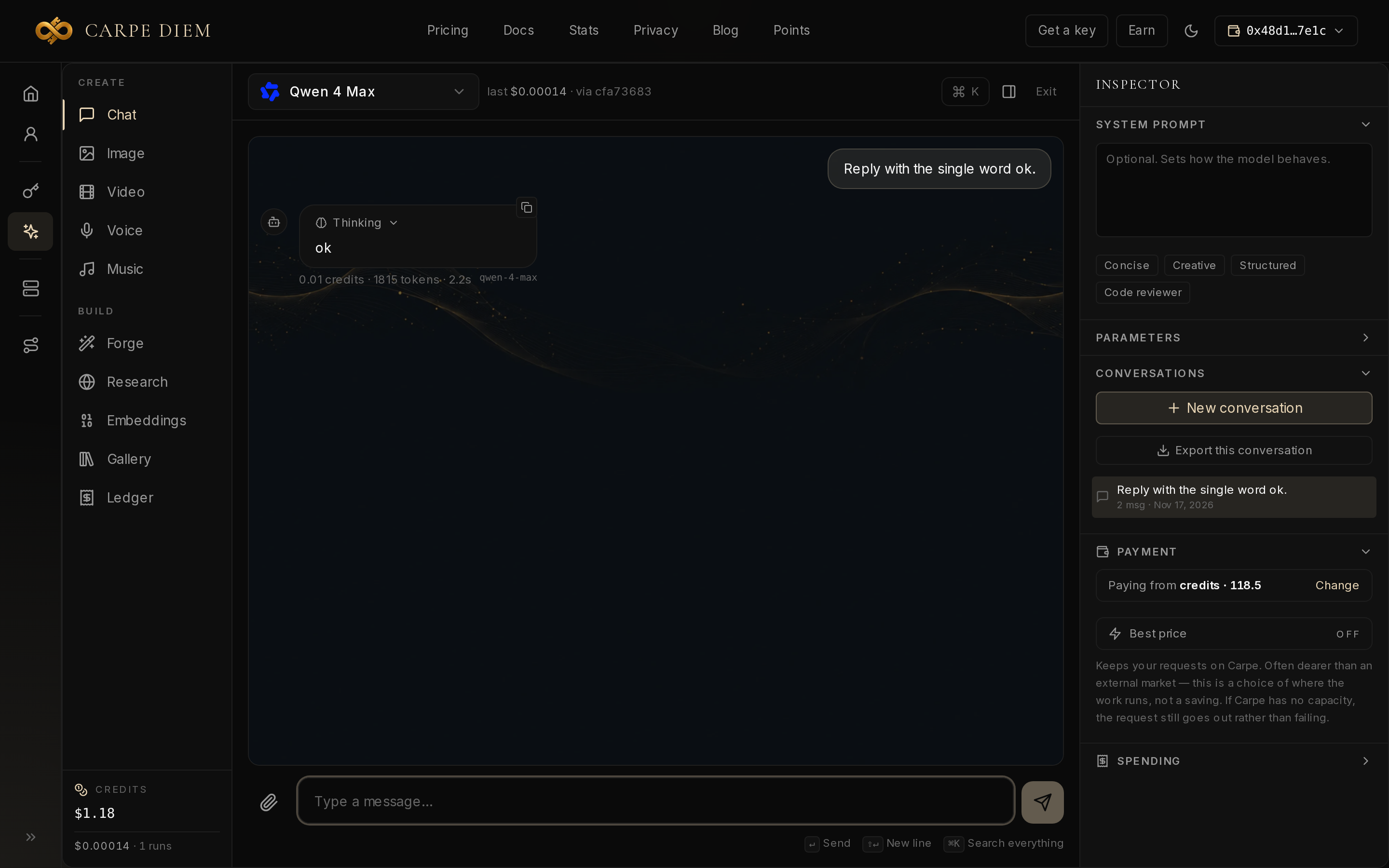
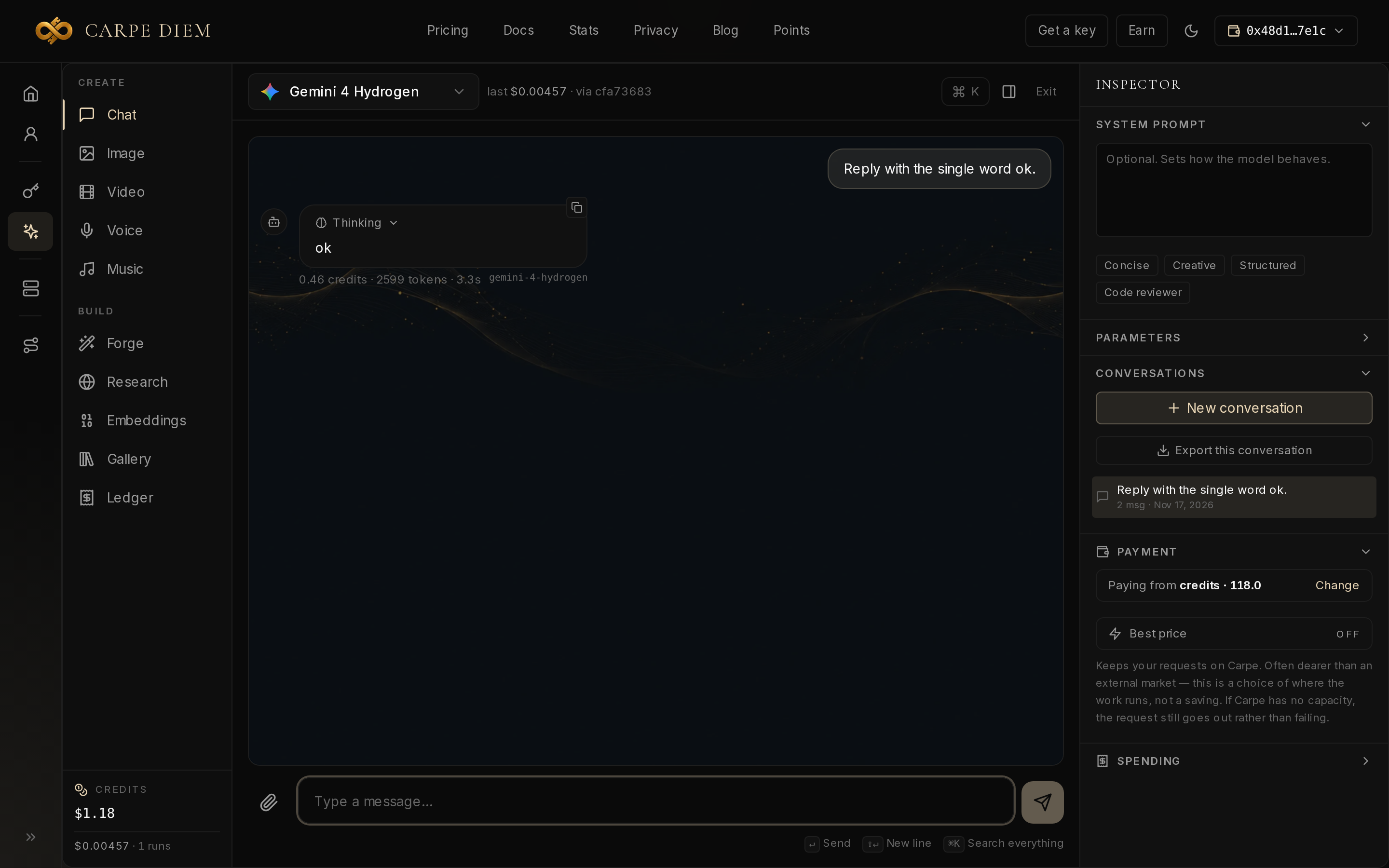
Writing is what split them: the task was a paragraph on what a model router is for. Hydrogen returned 104 words that read correctly, including the formal "you". Qwen exhausted the 1,200 allowed output tokens without returning any text. For a written deliverable, set a higher max_tokens limit or take Hydrogen. In Chat studio, the prompt "Reply with the single word ok." still returned ok from both.
Price: 41% under Venice at the time of the test
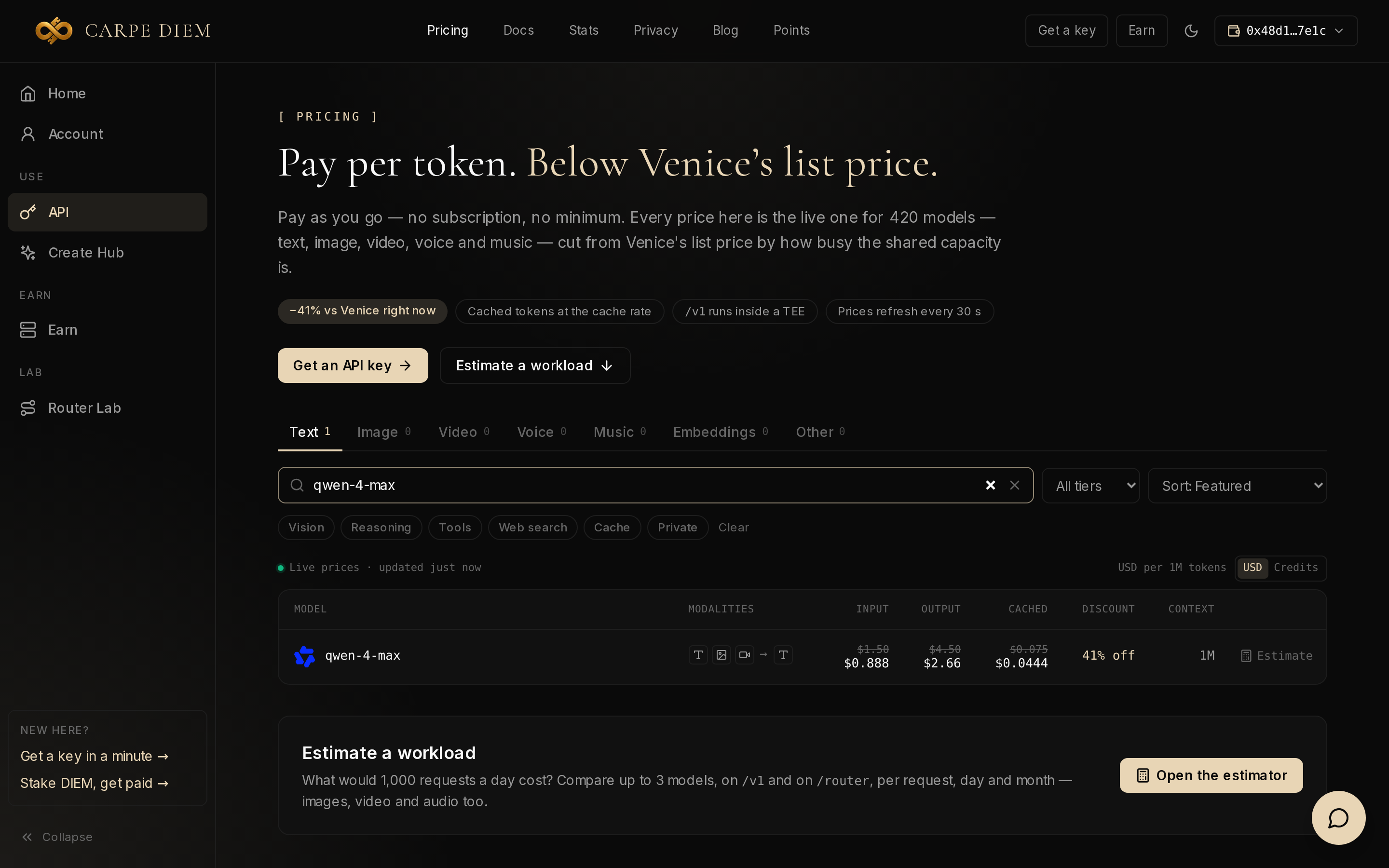
At the time of our test, Qwen 4 Max cost about $0.89 per million input tokens versus $1.50 on Venice, and Hydrogen $1.11 versus $1.875. In both cases that is about 41% under Venice. The price grid showed the same order: check it before you budget a large volume, because these prices move during the day.
The catalogue classes both models anonymized: Venice forwards the content to the vendor, which does not see the sender. Hydrogen also accepts audio input, which Qwen does not.
For short, frequent calls, add venice_parameters.include_venice_system_prompt: false, otherwise Venice appends its own system prompt, about 1,700 tokens per call.
When to take it, when to skip it
For JSON extraction, a short calculation, or finding a fact in a long text, we would take Qwen 4 Max: the same correct answers, the bill divided by four. That is the model to drop into an agent loop, as long as French is not the deliverable.
If the deliverable is a paragraph for a human, take Hydrogen, or give Qwen a higher max_tokens limit than we used. Hydrogen is also the only one of the two that accepts audio input.
For long agent coding at Anthropic, Claude Fable 5.2 costs clearly more. If you need a private model, Kimi K3.1 Pro is one, while both models today are anonymized. GPT-6.1 Terra remains an OpenAI option we already measured.
Try both models
Create a cdm_ key, then export CARPE_API_KEY=cdm_your_key_here and OPENAI_BASE_URL=https://carpe-diem.xyz/api/operator/v1. The snippet installs nothing; for Hydrogen, change the model value.
import json
import os
import urllib.request

url = os.environ["OPENAI_BASE_URL"].rstrip("/") + "/chat/completions"
req = urllib.request.Request(
    url,
    data=json.dumps(
        {
            "model": "qwen-4-max",
            "messages": [{"role": "user", "content": "Reply with the single word ok."}],
            "venice_parameters": {"include_venice_system_prompt": False},
        }
    ).encode(),
    headers={
        "Authorization": "Bearer " + os.environ["CARPE_API_KEY"],
        "Content-Type": "application/json",
    },
    method="POST",
)
with urllib.request.urlopen(req, timeout=90) as resp:
    headers = dict(resp.headers)
    body = json.loads(resp.read().decode())

print(body["choices"][0]["message"]["content"])
usage = body.get("usage") or {}
print("prompt_tokens", usage.get("prompt_tokens"))
print("completion_tokens", usage.get("completion_tokens"))
print("x-carpe-cost-usdc-micro", headers.get("X-Carpe-Cost-Usdc-Micro") or headers.get("x-carpe-cost-usdc-micro"))
print("model", body.get("model"))
This snippet returned ok for model qwen-4-max.
Try both models in the Create Hub and read the receipt under the reply before you freeze an id in your client.