GPT-6.2 Sol, Gemini 4 Neon or Terra: same bench, a 16x gap

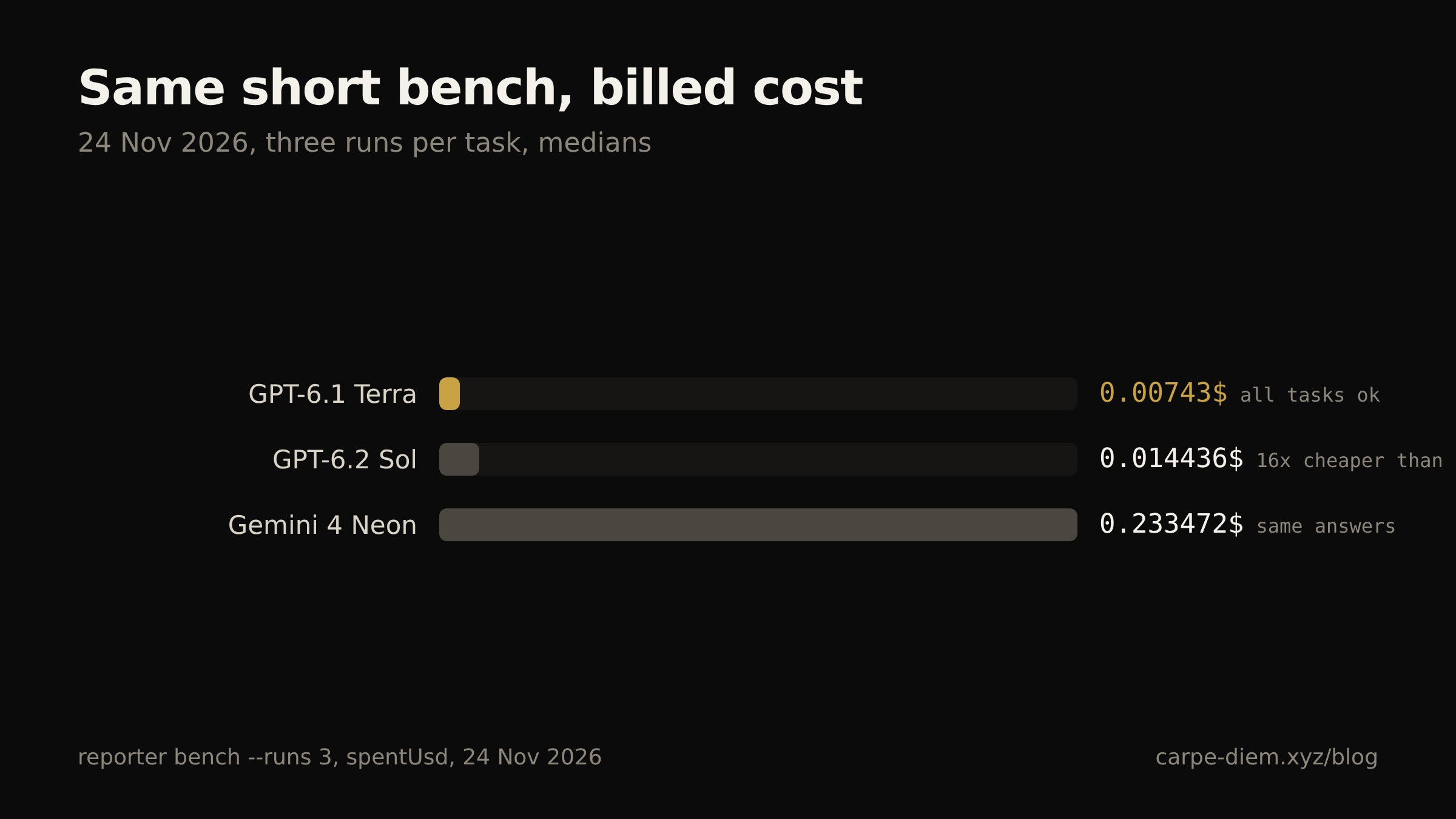
On the same benchmark, Gemini 4 Neon cost $0.23 and GPT-6.2 Sol $0.014, so Neon cost 16 times as much, for the same correct answers. GPT-6.1 Terra, half the price of Sol, also passed every task, at $0.007. OpenAI presented Sol on 17 November as its everyday model, and Google launched Neon the next day, drawing the comparison with Sol itself.
What we did
We ran the three models on the same tests on 24 November, three runs per task (we keep the medians): a break-even calculation, a JSON extraction, a needle in a text of about 2,500 words, a paragraph in French, and a JavaScript function, compressRanges. We did not test vision, audio, video, tools, or the million-token window, and GPT-6.2 Astra is not in this bench.
The announcements are on OpenAI and Google, with DeepMind's Neon model card.
The measurements: same answers, very different times
| Task | GPT-6.1 Terra | GPT-6.2 Sol | Gemini 4 Neon |
|---|---|---|---|
| Reasoning (threshold 40,000) | correct, 5.4 s | correct, 4.2 s | correct, 13.9 s |
| JSON extraction | valid, 1.8 s | valid, 2.0 s | valid, 9.7 s |
Needle 7319-KESTREL |
found, 2.3 s | found, 2.6 s | found, 7.6 s |
| French writing | 85 words, 4.1 s | 82 words, 3.9 s | 99 words, 21.9 s |
compressRanges code |
6/6 off harness, 3.6 s | 6/6 off harness, 3.2 s | 6/6 off harness, 15.3 s |
| First token | 1850 ms | 1254 ms | not measured |
| Full bench | $0.00743 | $0.0144 | $0.2335 |
Method: 24 November 2026, three runs per task, medians, prices at the time (Terra $0.55 / $2.75 per million tokens, Sol $1.10 / $5.50, Neon $2.0625 / $10.3125). The code harness did not find its test file: we extracted the functions and reran the 6 cases separately, all passed by all three models. Vision, audio, tools and very long context were not tested.
The cost gap is not only the rate card. On writing, Neon produced 2,326 output tokens for 99 words, versus 104 for Sol and 114 for Terra: more than twenty times as many tokens, billed like the rest. Sol uses informal "you" (« ton application »); Neon and Terra stay formal.
Price, against what it does
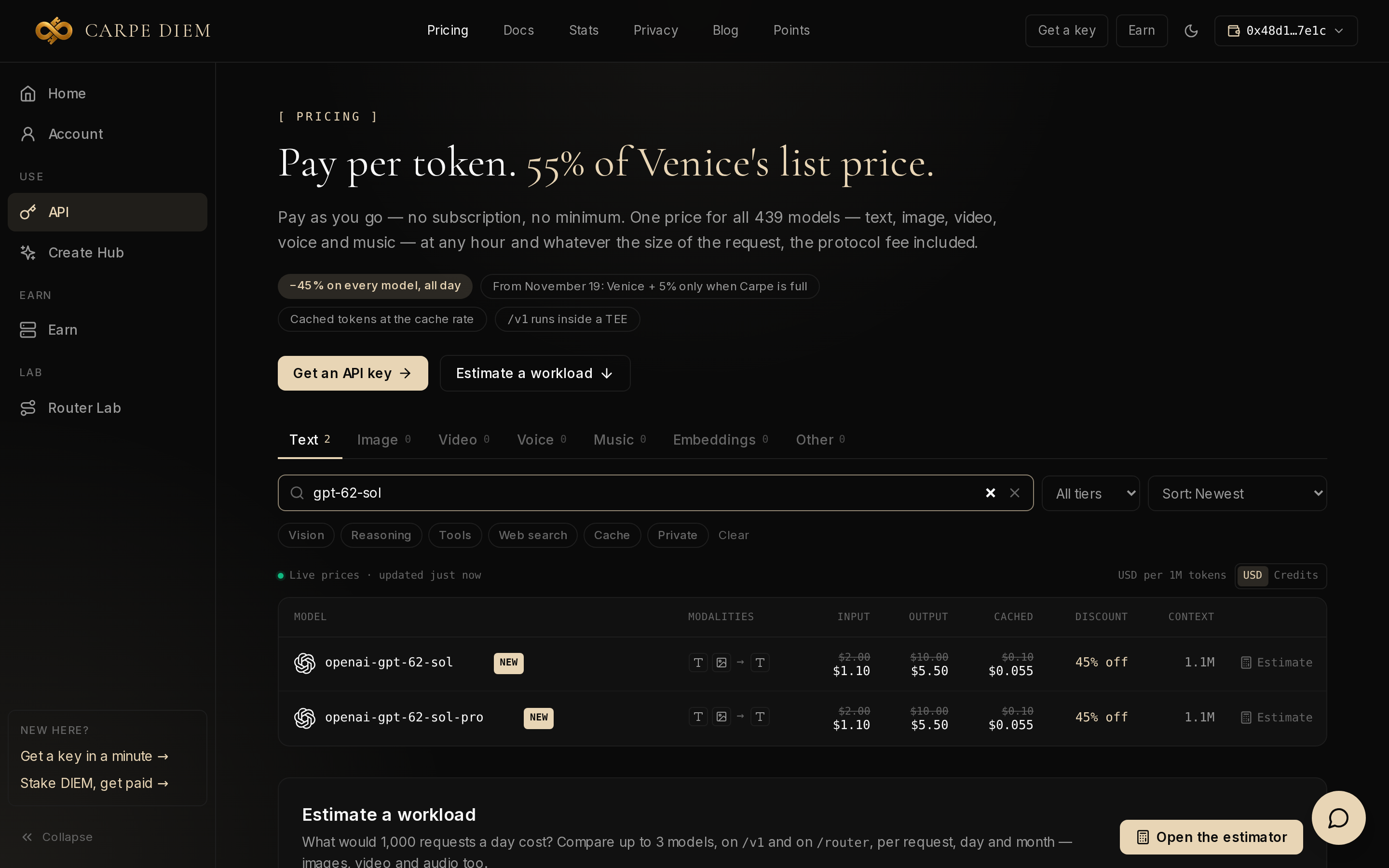
At the time of our test, all four models sit 45% under Venice list, according to the catalogue and /pricing. That price moves during the day: check it before you budget a large volume.
| Input / M | Output / M | Venice | Privacy | |
|---|---|---|---|---|
| openai-gpt-61-terra | $0.55 | $2.75 | $1 / $5 | anonymized |
| openai-gpt-62-sol | $1.10 | $5.50 | $2 / $10 | anonymized |
| gemini-4-neon | $2.06 | $10.31 | $3.75 / $18.75 | anonymized |
| openai-gpt-62-astra (not measured) | $4.40 | $22.00 | $8 / $40 | anonymized |
The three models we tested are anonymized: the vendor sees the content of your requests, not the sender. Neon also accepts audio and video in, which we did not try.
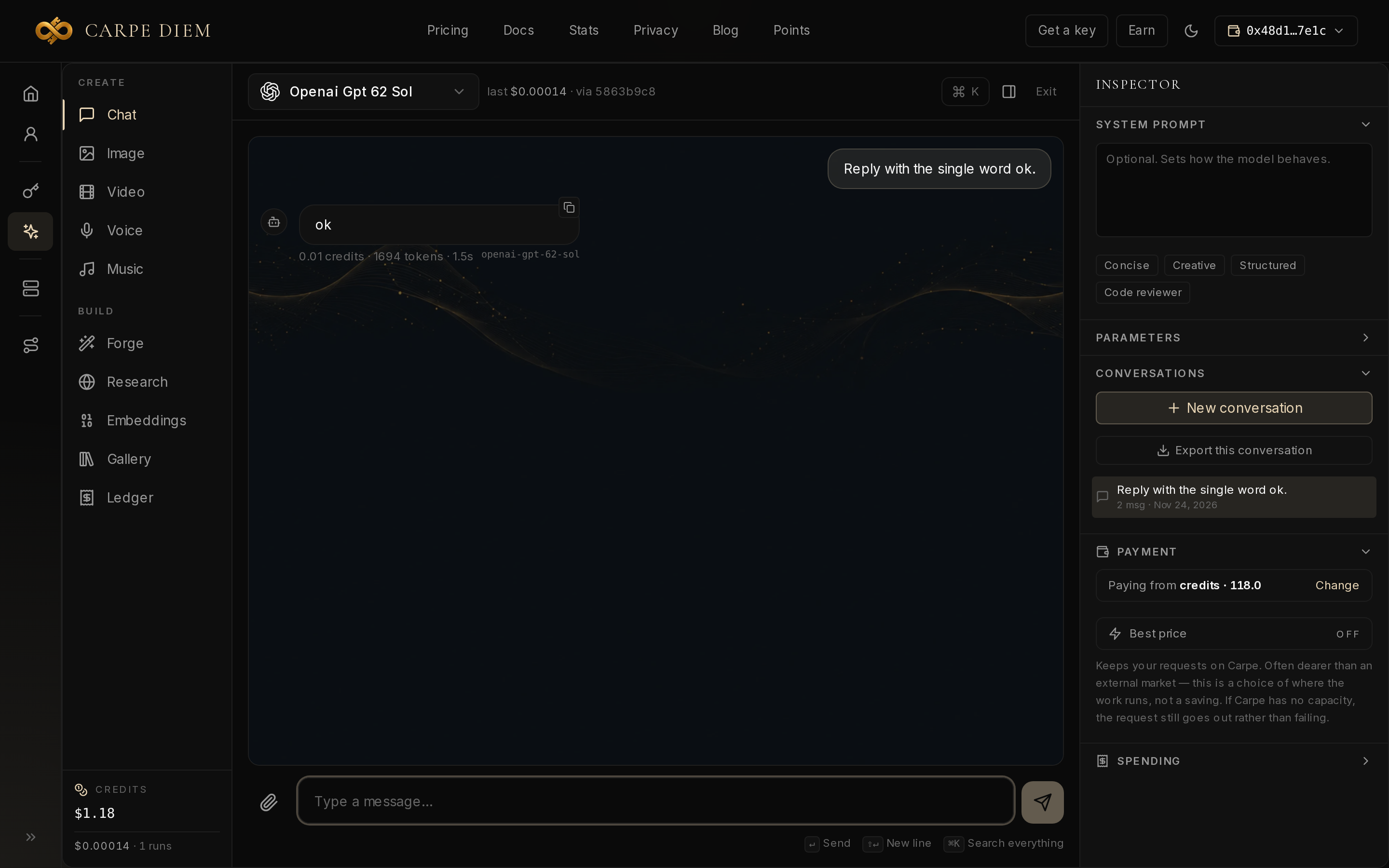
For short, frequent calls, add venice_parameters.include_venice_system_prompt: false. Our ok sent through the API with that field cost $0.000042 on Sol; in the Hub, without the field, the receipt showed $0.00014 for 1,694 input tokens.
When to take it, when to skip it
For JSON extraction, a short calculation, finding a fact, or writing a small function, we would take GPT-6.1 Terra: the same correct answers, a bill twice as low as Sol and 31 times as low as Neon. Its October verdict goes through its use cases in detail.
Between Sol and Neon for everyday work, take Sol: the same score here, first token in 1.25 s, 16 times cheaper. OpenAI puts Sol 0.5 points from Astra on FrontierCode, at about one fifth the cost per task on its own chart.
Keep Neon for what this bench does not measure: long agents, audio or video in, the ground where Google ranks it ahead of Sol (61 versus 57 on the AA Index, according to the card). On short text, its default reasoning inflates the bill without adding anything.
If your prompts must stay on a private model, look at Kimi K3.1 Pro instead. The other everyday duel is Qwen 4 Max versus Gemini 4 Hydrogen.
Try it in 30 seconds
Create a cdm_ key, then export CARPE_API_KEY=cdm_your_key_here and OPENAI_BASE_URL=https://carpe-diem.xyz/api/operator/v1. The snippet installs nothing; for Terra or Neon, change model.
import json
import os
import urllib.request

url = os.environ["OPENAI_BASE_URL"].rstrip("/") + "/chat/completions"
req = urllib.request.Request(
    url,
    data=json.dumps(
        {
            "model": "openai-gpt-62-sol",
            "messages": [{"role": "user", "content": "Reply with the single word ok."}],
            "venice_parameters": {"include_venice_system_prompt": False},
        }
    ).encode(),
    headers={
        "Authorization": "Bearer " + os.environ["CARPE_API_KEY"],
        "Content-Type": "application/json",
    },
    method="POST",
)
with urllib.request.urlopen(req, timeout=90) as resp:
    headers = dict(resp.headers)
    body = json.loads(resp.read().decode())

print(body["choices"][0]["message"]["content"])
usage = body.get("usage") or {}
print("prompt_tokens", usage.get("prompt_tokens"))
print("completion_tokens", usage.get("completion_tokens"))
print("x-carpe-cost-usdc-micro", headers.get("X-Carpe-Cost-Usdc-Micro") or headers.get("x-carpe-cost-usdc-micro"))
print("model", body.get("model"))
Actual output: ok, 13 input tokens, 5 output tokens, $0.000042, model openai-gpt-62-sol.
Run the snippet on Sol, change model for Terra and Neon, then compare the three in the Hub.